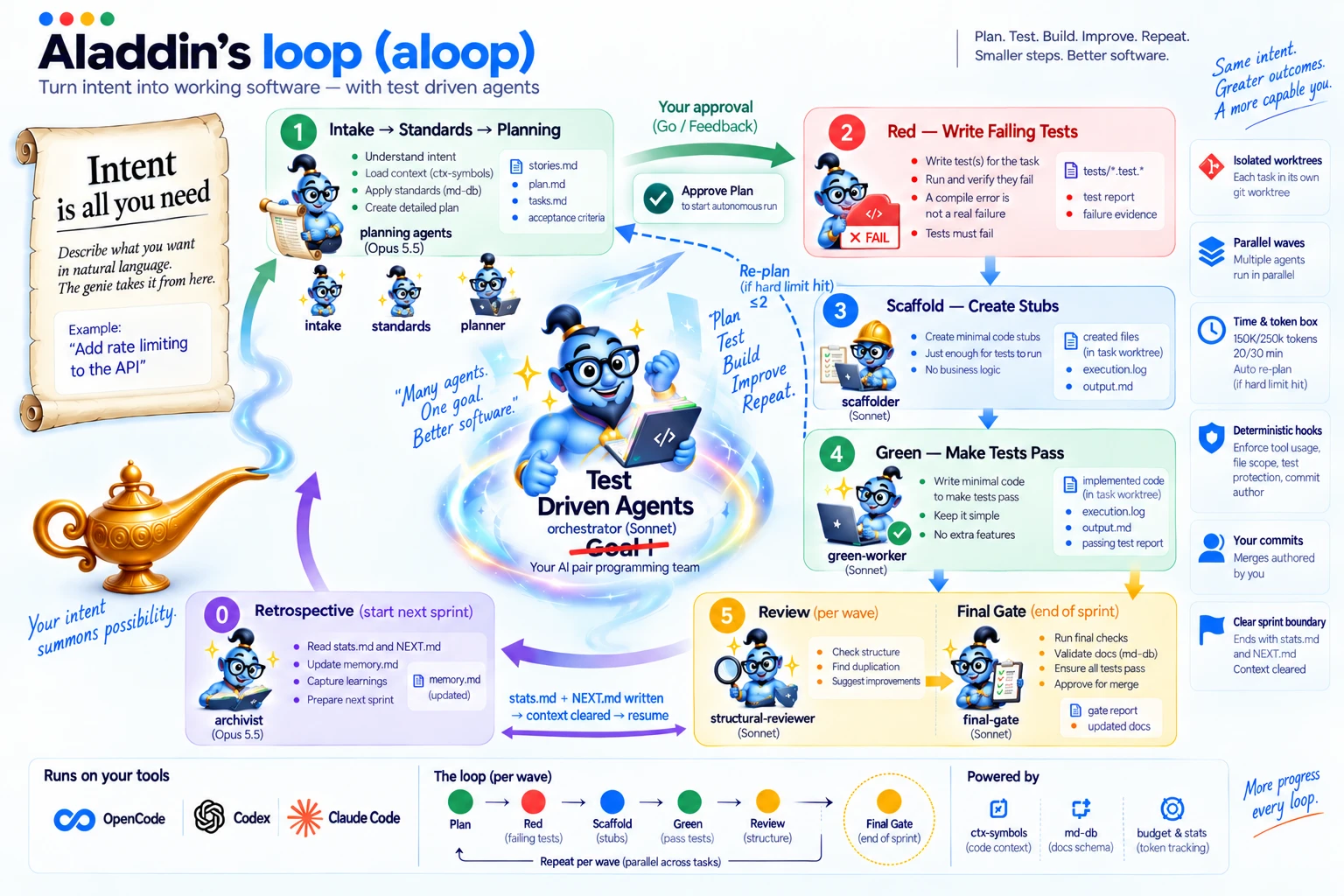
Your harness is the hardware. aloop is the kernel: its gates decide what is accepted, modules plug in the checks your project needs, and a distro (software: the TDD loop) is the user space you run and change. You give one line of intent; cheap workers build it, test first, in isolated worktrees.
# add the marketplace and install the plugin
/plugin marketplace add adeelahmad/aloop
/plugin install aloop@aloop-marketplace
/reload-plugins

# say what you want
/aladdin Add rate limiting to the API
intake → standards → planner
✕ 3 tests fail (RED proves what is missing)
✓ 3/3 pass in the task worktree (GREEN)
◆ FINAL-GATE pass · merged, authored by you
Your intent summons possibility.
Inside Claude Code. A Rust toolchain 1.85+ lets the plugin build its gate backends (ctx-symbols, md-db) on first start; without it the gates degrade to grep.
# add the marketplace and install the plugin
/plugin marketplace add adeelahmad/aloop
/plugin install aloop@aloop-marketplace
/reload-plugins

# say what you want
/aladdin Add rate limiting to the API
The skill triggers on any build, fix or change request in your own words. /aloop:aladdin is the same skill.
aladdin "Add rate limiting to the API" records the intent and prints the line to say in your host. It does not start a run on its own. Follow a run with aladdin status; pick it up in a fresh session with aladdin resume.
Codex, OpenCode and DeepSeek Harness install with aloop install codex|opencode|dsh: the install guide.
Each step is a sub-agent in its own git worktree, and a hook intercepts its stop. Waves run in parallel across tasks; the final gate runs once per sprint.
ctx-symbols)md-db)md-db), all tests passGive the agent something to make false. A test written after the code proves the code does what the code does. A test written before it proves the code is missing, so "done" becomes a claim a gate can check, not a sentence a model can say. A gate that crashes blocks; a BLOCK is never downgraded to a warning.
gate-red-verifyTests passed on the first run: RED needs failing proof.
gate-green-verify3/3 tests pass in the task worktree, inside its scope.
gate-green-verifyScope: touched src/app.py outside the task's targets.
gate-door-planA push to the default branch waits for your typed authorization.
| The model may | The gate decides |
|---|---|
plan, split, pick a route (strongest · strong · economical) | whether the plan has tests for every task and targets that exist or are declared |
| write tests, scaffolds, code, reviews | whether RED fails, SCAFFOLD has no bodies, GREEN passes inside its scope |
| say it is done | nothing: done is a passing gate verdict in the event stream |
| spend tokens and minutes | within a box: soft warning, hard stop, breach classified and re-planned, never retried as is |
Each task in its own git worktree.
Multiple agents run in parallel.
Every attempt boxed; auto re-plan on a hard limit.
Enforce tool usage, file scope, test protection, commit author.
Merges authored by you.
Ends with stats.md and NEXT.md; context cleared.
Every run leaves an aladdin.event/1 stream. Decisions carry a one-line reason, evidence refs and an authority ref; usage is reported by class and marked estimated where a host does not report it.
$ aloop events trace 3e555af
commit 3e555af   feat: rate limiting (built from the task's rationale)
└─ task S1-01-T2  "wire the limiter"            worktree merged --no-ff
   └─ attempt 2   green-worker · economical      gate-green-verify: PASS
      ├─ attempt 1   gate-green-verify: BLOCK     scope: touched src/app.py outside targets
      └─ targets C2  modify src/api.py:12 handle  reason: handle checks the limit
         └─ plan S1-01  granted by the typed intent  autonomy: autonomous (M11)
            └─ intent int_01a14d9f…  "Add rate limiting to the API"
A one-line intent, start to merged code, in a real Claude Code session. Every row is in the evidence ledger with the command that reproduces it: make e2e-live YES=1 INTENT=<intent>.
| Intent | Result | Time | Cost |
|---|---|---|---|
| a Rust semver parser (run 21) | 12/12 checks | 8m17s | $0.66 |
| a Rust word-frequency tool, two dependent stories (run 27) | 13/13 checks | 9m54s | $0.70 |
| a Python slugify package, pytest (run 37) | 12/12 checks | 9m42s | $0.69 |
a Go Roman-numeral package, go test (run 39) | 12/12 checks | 7m52s | $0.56 |
a JS camelCase module, node --test (run 41) | 12/12 checks | 6m45s | $0.56 |
| extend an existing crate, brownfield (run 42) | 13/13 checks, seed tests untouched | 7m11s | $0.67 |
| a wc-like CLI app, tested by running it (run 46) | 13/13 checks, the merged binary works | 15m19s | $0.99 |
Think of it as a computer. The harness (Claude Code, Codex, OpenCode, DeepSeek Harness) is the hardware. aloop is the kernel: the gate engine, its gates and the audit log, never overridden. Modules plug into the kernel: use an existing one, or build one for what your project needs. Above them runs a distro: the user space (agents, prompts, skills) that shapes the loop, yours to eject and change in git. The software distro, the TDD loop, ships today.
aladdin.event/1)SubagentStop or Stopsoftware (TDD) by default# 1. scaffold a module: module.json + an executable check $ aloop module new no-todo --on Stop created ~/.aloop/modules/no-todo # module.json {"name": "no-todo", "on": ["Stop"], "command": "./check", "timeout": 120} # check: exit 2 blocks, stderr is the reason grep -rn TODO "$ALOOP_PROJECT/src" && { echo "TODO left in src/" >&2; exit 2; } exit 0
# 2. add it: its sha256 goes in distro.json, in git
$ aloop module add no-todo
added no-todo 0b4d8588bc1c

# 3. shape the loop: eject the distro's user space, edit, apply
$ aloop userspace eject
ejected 78 file(s) into docs/agents/userspace
$ aloop userspace apply

# 4. or bundle modules + user space as a distro
$ aloop distro new my-distro
$ aloop distro install ./my-distro

# at the sprint's stop, beside the core gates
◆ module no-todo blocked: TODO left in src/
Every command above ran as shown. A check sees ALOOP_EVENT, ALOOP_ROLE, ALOOP_PROJECT, ALOOP_DISTRO and ALOOP_MODULE; a crash, a timeout, or a module missing or changed since it was added blocks too, and every run is a module.run audit event. The full how-to: Build your own module. The rules: ROADMAP §4.15.
Every requirement, its status and the test that proves it: ROADMAP.md · TRACKING.md.
| Milestone | What | Status |
|---|---|---|
| M0 to M7 | hygiene, trustworthy state, budgets that plan, clean boundaries, intent contracts, narrow context, audit, any host | Shipped v0.12.0 |
| M8, Aladdin 1.0 | /aladdin and the CLI, this site, measured public runs on every host | In progress |
| M9, mission layer | missions, journeys, baseline, goals: the loop picks its next goal | In progress |
| M10, agent habitat | contained workers, a supply-chain gate, fetched content as data, one project stop | In progress |
| M11, autonomous by default | the typed intent is the grant; only one-way doors ask | In progress |
| M12, kernel and user space | aloop is a kernel for your harness: modules plug in, distros (software: TDD) are yours to eject and change | In progress |
ctx-symbolsmd-dbbudget & stats